Module One
The Octopus
Read children's needs
The octopus is a body that thinks, sensing the world through eight arms while staying connected to the whole. We begin here, and your educators will leave this module reading a busy room differently.
Regulation Rituals® is designed to align with the professional learning and inclusion priorities behind Kindy Uplift, Preschool Boost and Inclusion Ready — one investment that supports several.
See how it aligns →
Your educators may already have calm spaces, visual schedules, sensory resources, transition songs, breathing cards and an enormous amount of care. They may have attended training, downloaded resources and tried many different approaches. And yet they may still find themselves wondering:
Why did that moment escalate so quickly?
Why can this child manage one day and be overwhelmed the next?
Do I hold the boundary, change the expectation or offer connection?
How do I support one child while staying present for the rest of the group?
How do we stay consistent without becoming rigid?
How do we do all of this without adding pressure to already-stretched educators?
Regulation Rituals® was created for the space between caring deeply and knowing what to consider next.
Bring Regulation Rituals® to your team →
Educators care deeply about the children they support. The challenge is that regulation is often taught through disconnected ideas, isolated strategies and different professional perspectives. One educator may have completed sensory training, another may understand attachment, while someone else is drawing on behaviour guidance, trauma-informed practice or their own experience.
Each piece can be valuable, but without a shared framework, teams are left trying to bring it all together in the middle of a busy early learning day. Educators respond differently, strategies are used inconsistently, and everyone is left wondering why the approach isn't creating the change they hoped for.
One educator reads a child's behaviour as a sensory need.
Another sees a boundary issue.
Another calls it attention-seeking.
Everyone is trying their best — but everyone is working from a different map.
Your team develops a shared language for what they're noticing, and a more thoughtful process for deciding how they may respond.
The goal is not to turn educators into clinicians. It's to help them become more confident, curious and intentional educators.
Implementation doesn't depend on finding more hours in the day. It begins with learning to see the arrivals, transitions, group experiences and repeated rhythms already happening, and shaping them into meaningful, predictable rituals.
Each module builds on the one before it, connecting the ideas rather than collecting more disconnected information.
Not an eight-week course. Your team moves at a pace that's realistic within the life of a real early childhood service.
Two circles a week with Sally, held at different times so there is usually one that fits around shifts. No module depends on attending, so nobody falls behind.
How it maps to your priorities
Regulation Rituals® doesn't sit beside the work your service is already doing — it strengthens the outcomes you're already accountable for. Here's how it maps to the major early-childhood priority frameworks.
Kindy Uplift · Queensland
Social and emotional learning Strong
Strengthens relational practice, emotional language, co-regulation and children's meaningful participation in social experiences.
Access and inclusion Strong
Culturally safe, inclusive and responsive kindergarten programs — equity and access for all. Builds capability to recognise participation barriers and create more accessible, responsive and inclusive early learning experiences.
Executive function Strong
Strengthens understanding of the foundations supporting focus, flexibility, impulse control, working memory, persistence and problem-solving.
Physicality Supports
Connects regulation with movement, sensory learning, body awareness, fine and gross motor participation and accessible physical experiences.
Language and literacy Contributes
Expands the language educators use to support emotional understanding, body awareness, communication and shared meaning.
Queensland doesn't maintain or endorse an approved supplier list. Kindy Uplift funding may be directed to professional development that builds educator capability and inclusion.
Preschool Boost · South Australia
Emotional maturity Strong
Supports understanding of emotional regulation, stress-related communication, emotional language, co-regulation and predictable relational experiences.
Social competence Strong
Strengthens capability to support belonging, relationships, shared experiences, co-regulation and socially responsive environments.
Physical health and wellbeing Supports
Connects sensory processing, body awareness, movement and environmental design with children's ability to access and engage in the day.
Language and cognitive skills Contributes
Supports the foundational regulation and executive capacities involved in attention, memory, flexibility, engagement and persistence.
Communication skills and general knowledge Contributes
Builds shared emotional and body-based language while supporting varied communication styles and inclusive access to group experiences.
Designed to contribute to educator capability and service-level practice across all five AEDC domains — aligned with Preschool Boost and AEDC priorities. It does not guarantee changes in individual child development or future AEDC results.
Inclusion Ready
Helps teams move beyond placing responsibility for inclusion solely on the individual child, and instead consider the relationships, environments, expectations and teaching practices that shape access and participation.
EYLF V2.0 & National Quality Standard
EYLF V2.0
Secure, respectful & reciprocal relationships · Equity, inclusion & high expectations · Responsiveness to children · Play-based learning & intentionality · Learning environments · Critical reflection & professional learning · Collaborative leadership & teamwork · Wellbeing & confident involvement in learning
National Quality Standard
QA1 · Program & practice · QA3 · Physical environment · QA5 · Relationships with children · QA6 · Partnerships with families · QA7 · Governance & professional learning
Can support service reflection, professional learning and improvement planning across these areas. Participation does not guarantee a particular assessment and rating outcome.
The whole method lives in one online portal, alongside the community. Educators watch a full module on the laptop during planning time, or dip into a single ritual on their phone between experiences. Progress saves as they go.
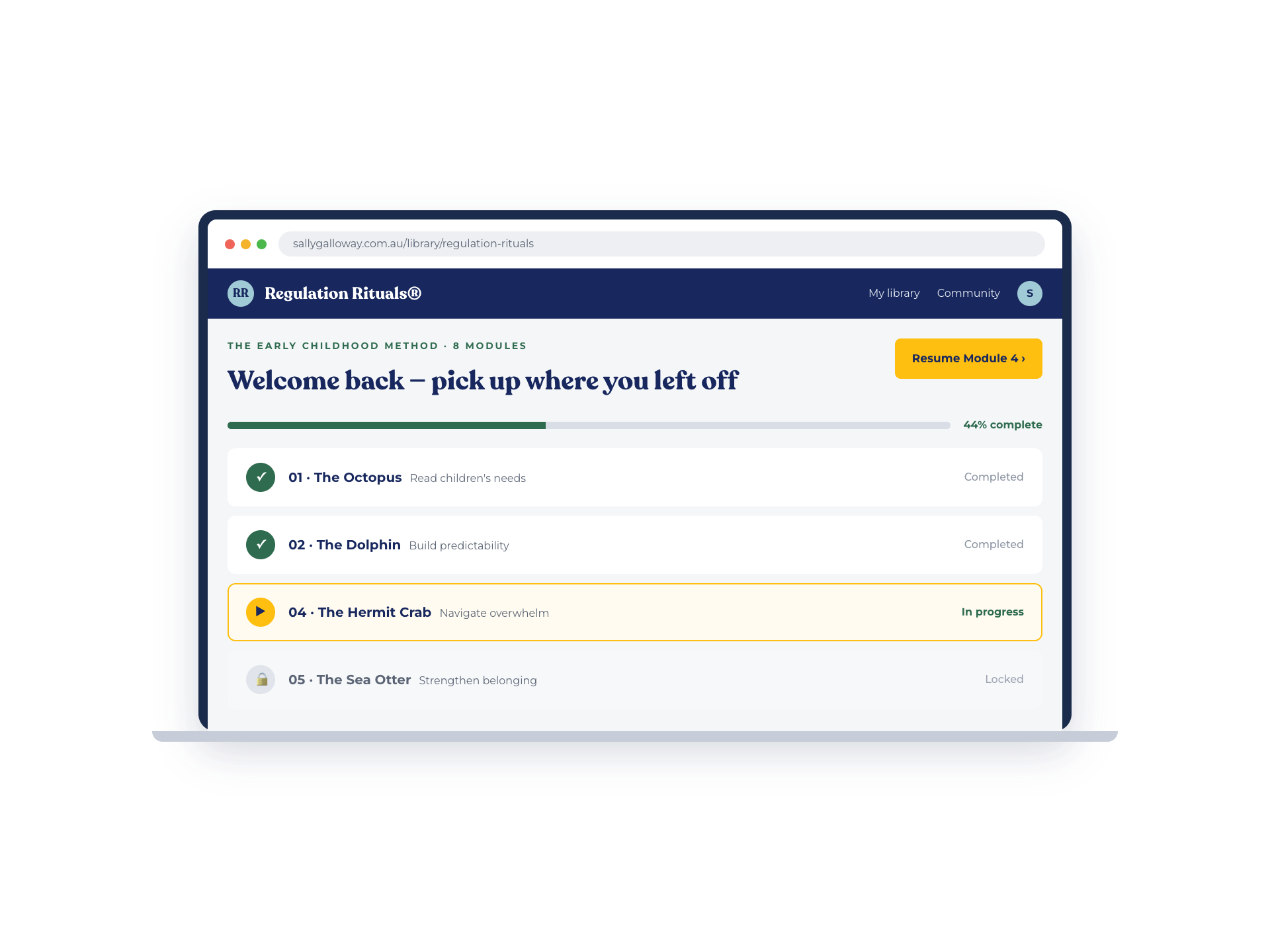
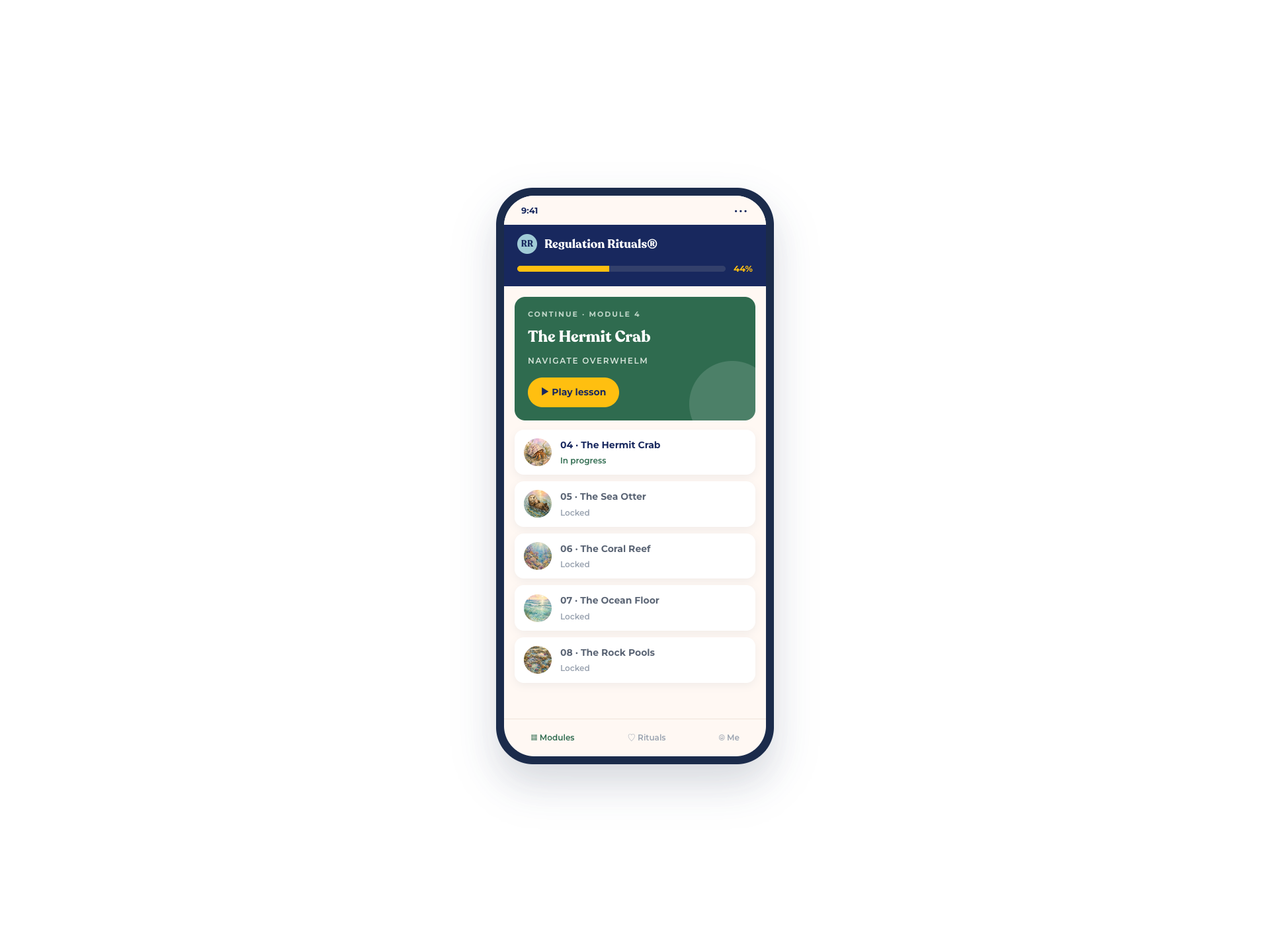
Each module takes a creature or a structure from the ocean, not as decoration, but because each one describes precisely what that module teaches. It is also why educators still have this language months later, at handover, in the moment it matters.
The octopus is a body that thinks, sensing the world through eight arms while staying connected to the whole. We begin here, and your educators will leave this module reading a busy room differently.
A dolphin sends its signal out ahead, reading what is coming before it arrives. Why two children standing in the same corridor are having genuinely different experiences, and why Monday and Friday are not the same day.
The whale surfaces to breathe before anything has gone wrong, because its body has been reading itself all along. This is where your educators will find language for the child who seems to give no warning at all.
A hermit crab between shells is soft and exposed, not because something has gone wrong with it, but because it is in transition. What is actually happening inside a child during a hard moment, and why the responses that come most naturally to an adult are often the least available to the child.
Sea otters hold hands while they sleep, anchoring to the kelp so the current cannot carry them apart in the night. Why the educator who gets it wrong and comes back matters more than the educator who never gets it wrong at all.
The reef does not manage the ocean. It is the living structure everything else depends on. This module is about the educator's own nervous system, treated as core professional practice rather than as a wellbeing afterthought.
The floor is what you lay down before anything else. You cannot see it from the surface, but it determines what grows and what survives the storms. This is where your team designs its Regulation Rituals, and where the care practices of the day stop being logistics.
A rock pool is shaped by what returns to it, the tide, the light, the shelter, until it becomes a world of its own. Nobody instructs a child at a rock pool. You set the conditions, and the child goes in. This is where the rituals move into your intentional teaching and your provocations.
The overview above shows the professional learning journey and intended outcomes of each stage. The full curriculum, proprietary frameworks, case material and participant tools remain inside the enrolled program.
Each module pairs its lessons with a printable workbook, a reflection worksheet and a practice card set, so the thinking travels off the screen and into planning meetings, staff rooms and everyday practice.
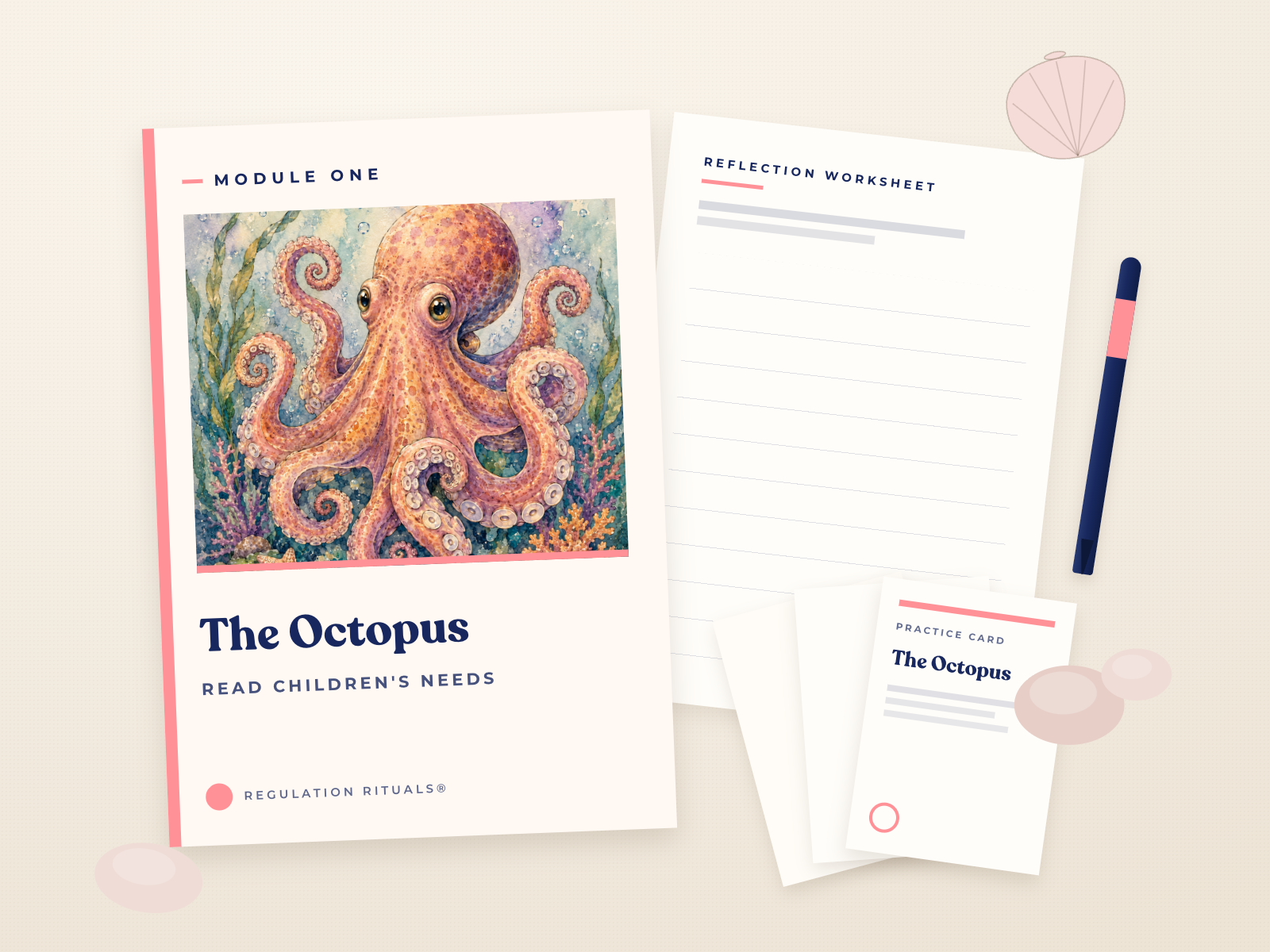
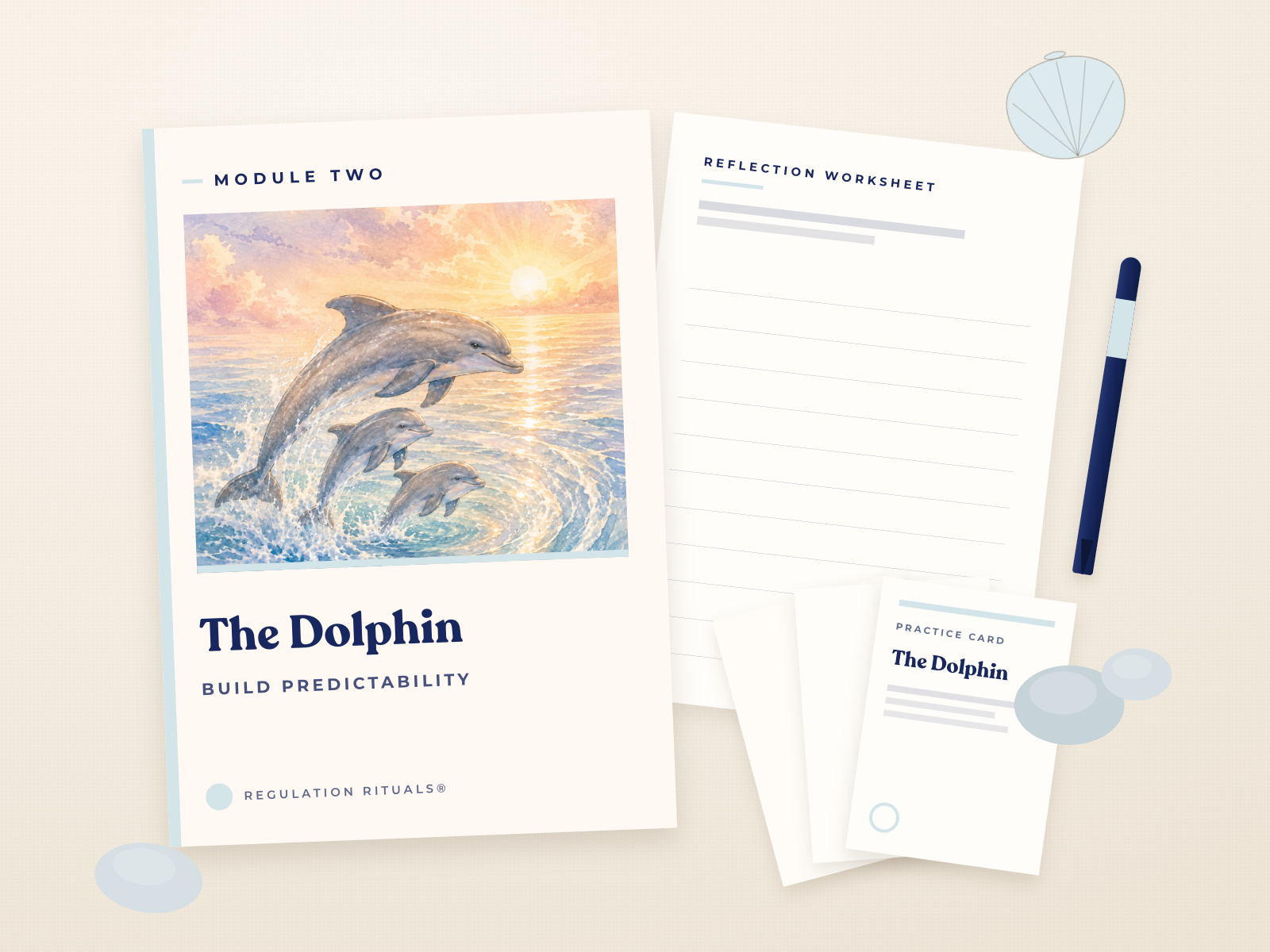
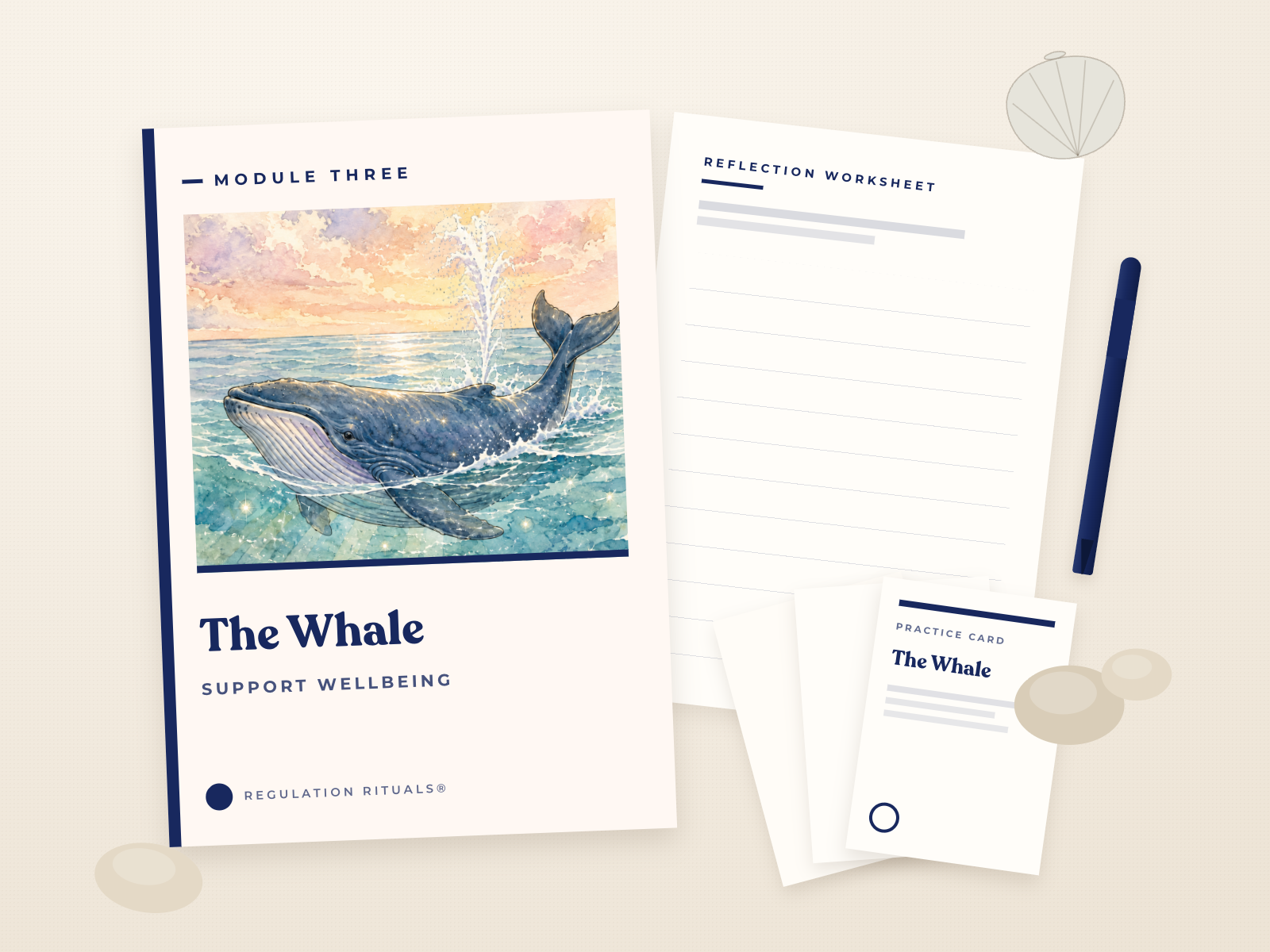
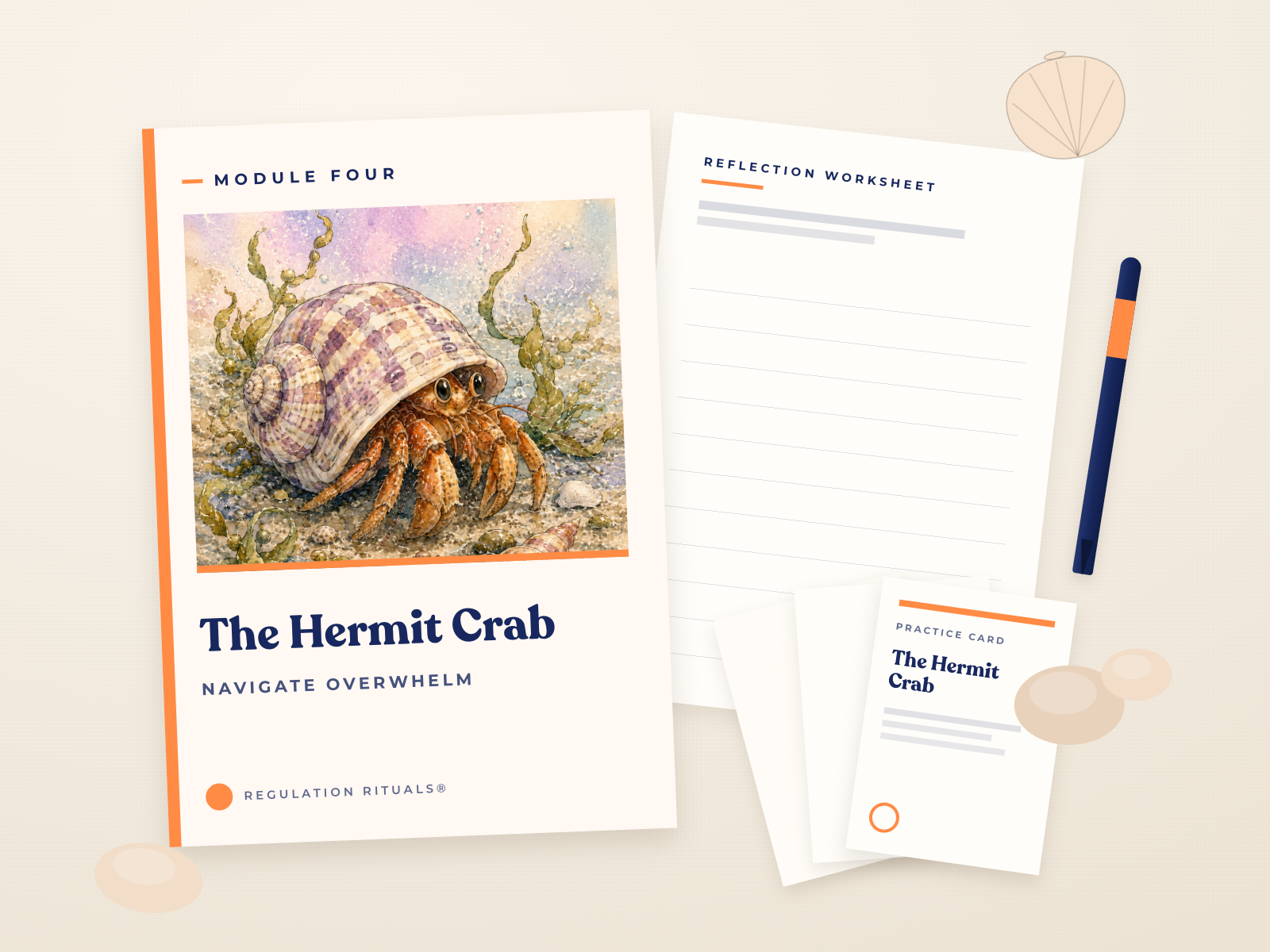
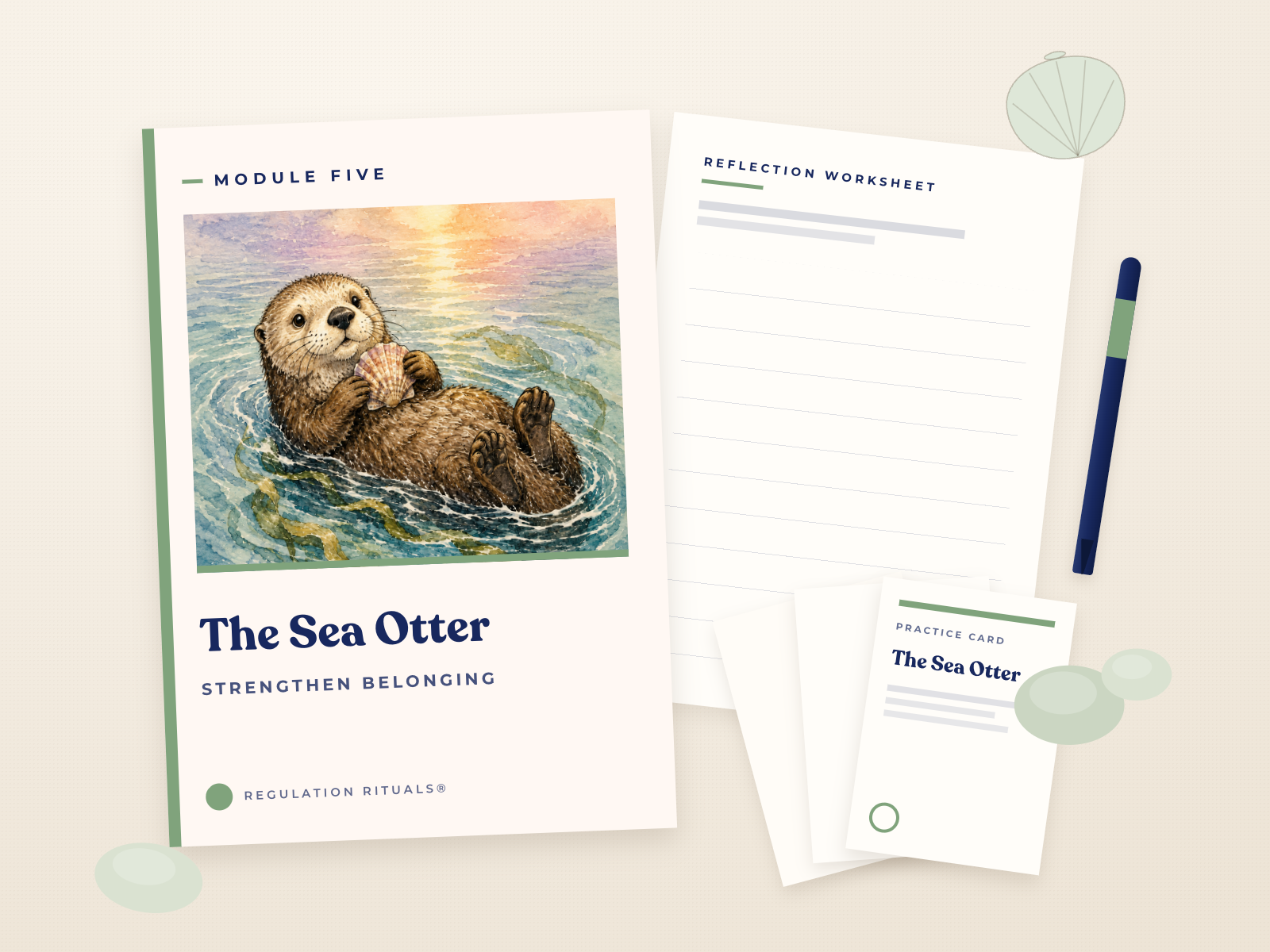
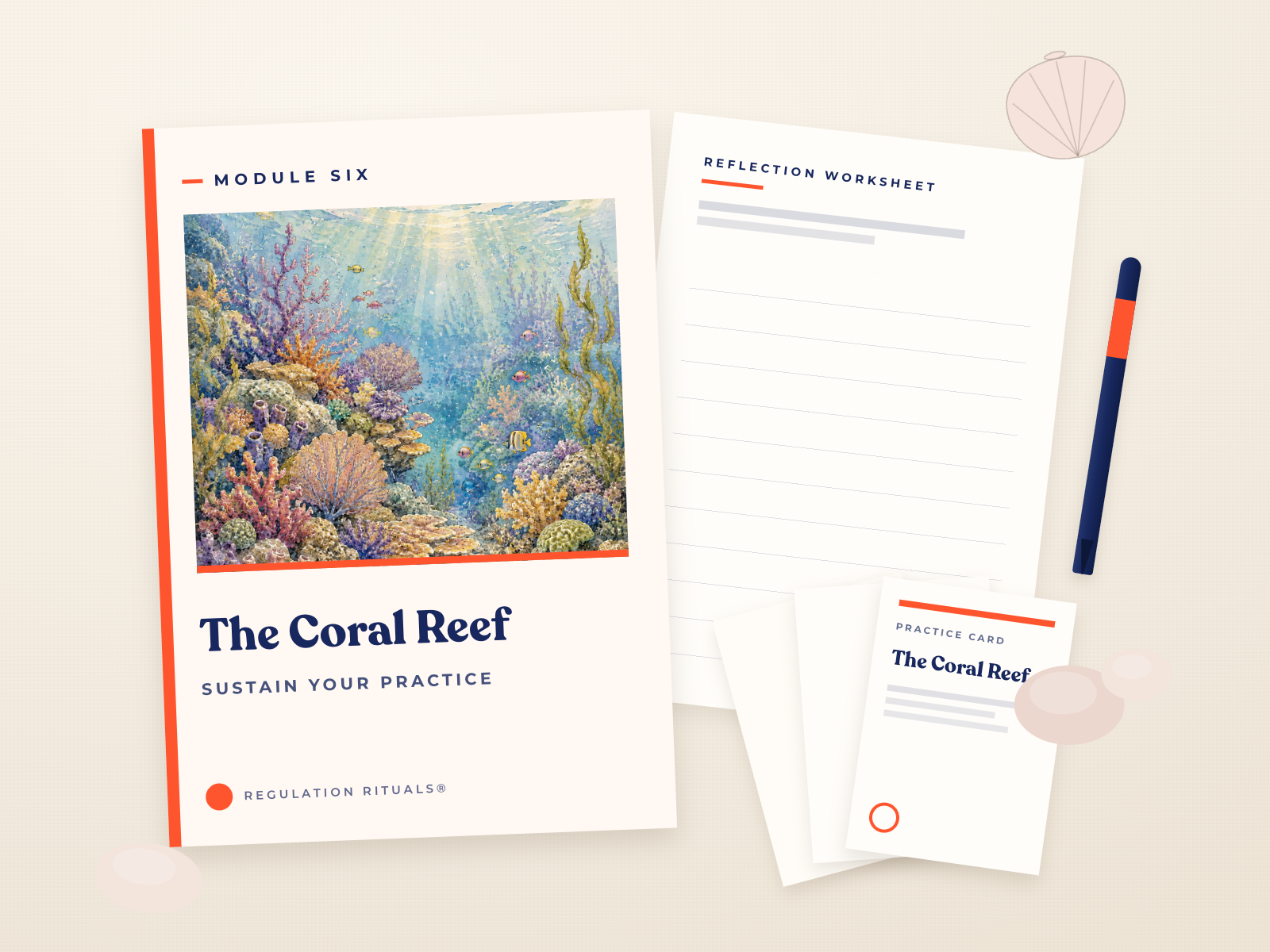
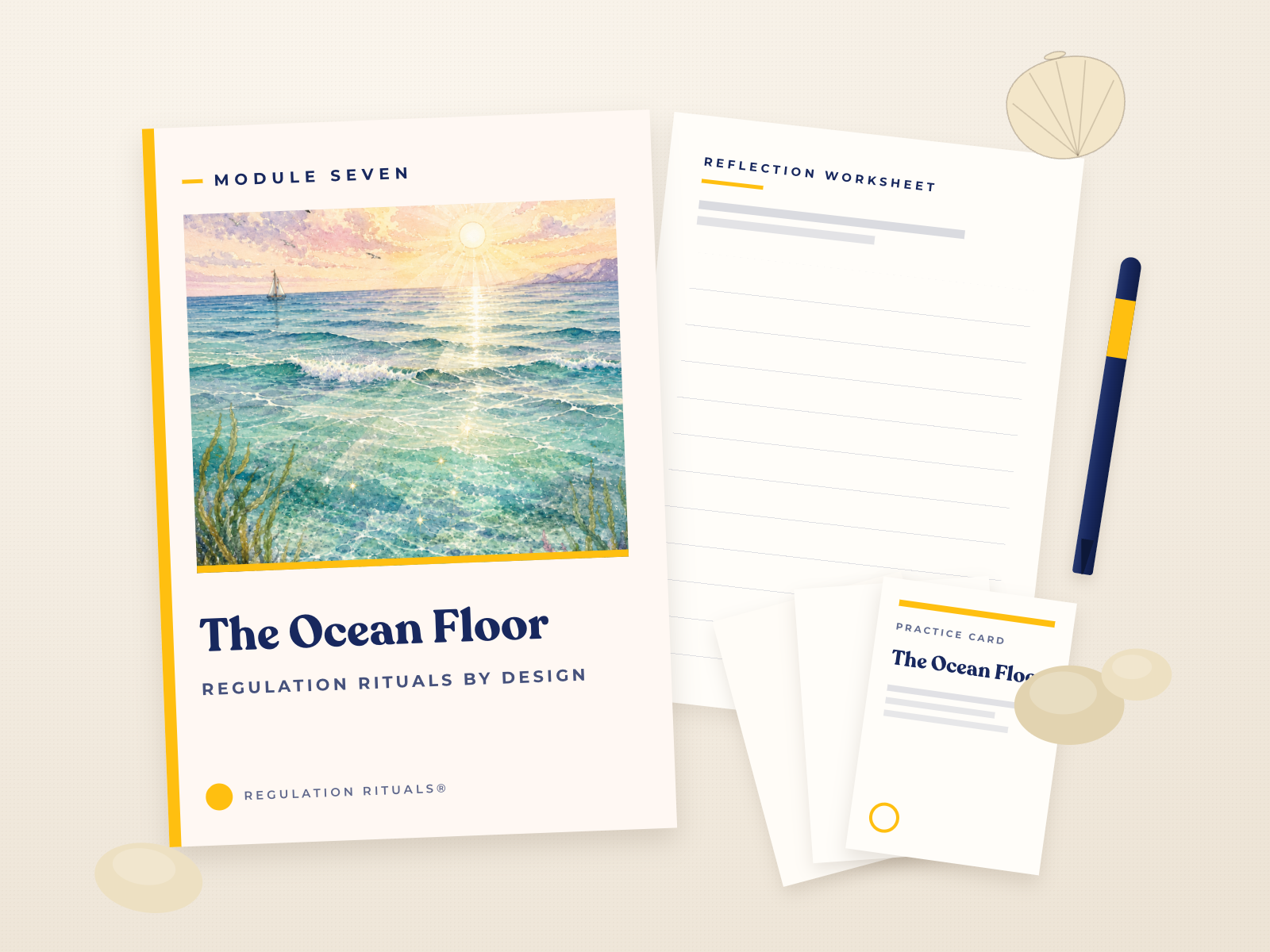
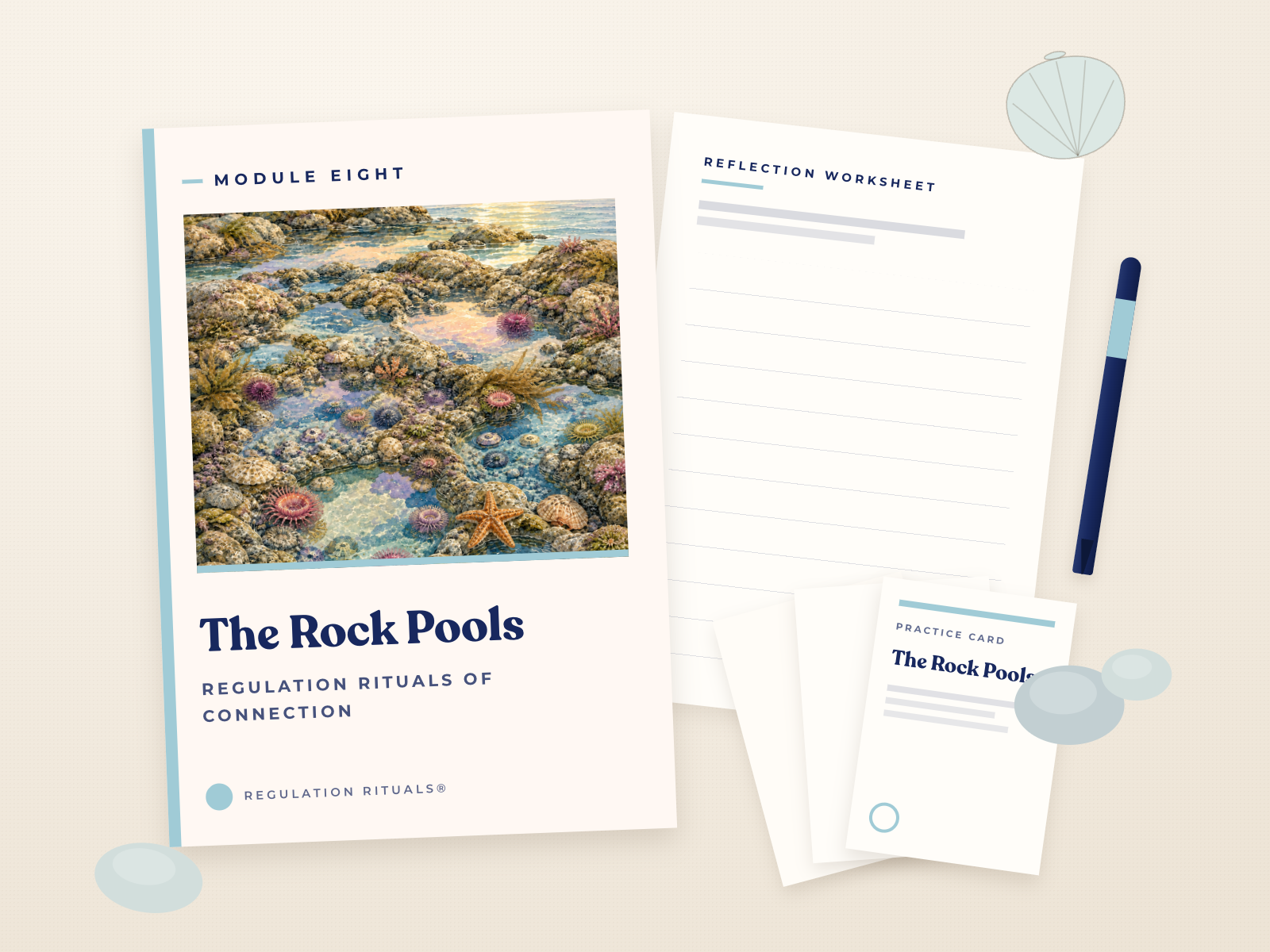
Sequenced learning that moves educators from foundational understanding into relational, sensory, environmental and intentional practice.
Move through the program at a manageable pace, revisit key concepts and return as understanding develops.
Live sessions with Sally twice a week during school terms, held at different times so there is usually one that fits around shifts. Attending is never required to complete a module.
Not a social media group. A professional space that lives alongside the modules, where educators bring the moments they are still thinking about and hear how other services have approached something similar.
Supporting materials that connect course content with your own context through observation, reflection and team discussion.
The Team Licence lets the people working together each day develop the same knowledge and shared professional language.
Access the modules from different locations and work through the content around service responsibilities.
Participants who complete the eight modules receive a certificate documenting their participation in the program.
Greater consistency in how children are seen, spoken about and supported across your service.
See team enrolment →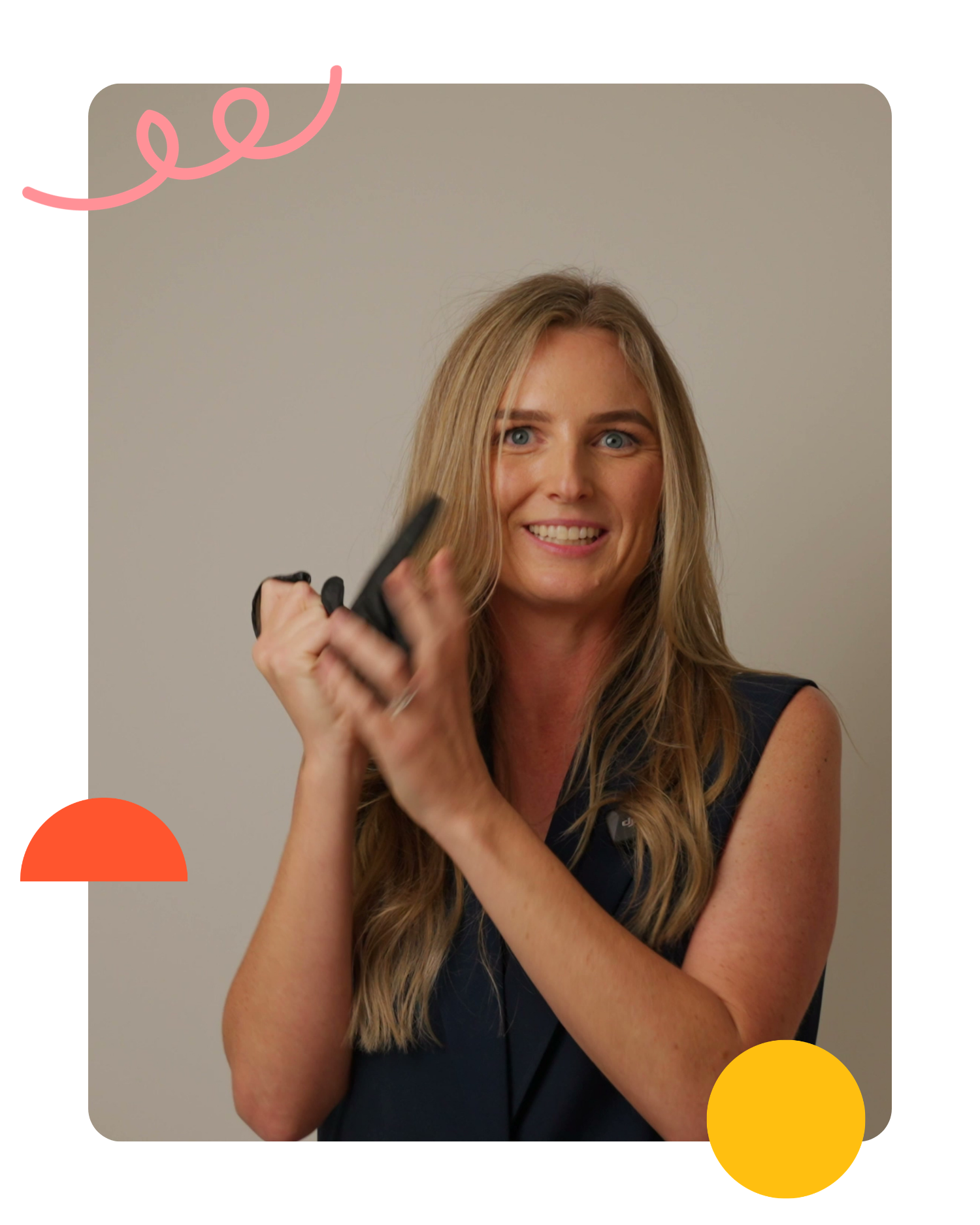
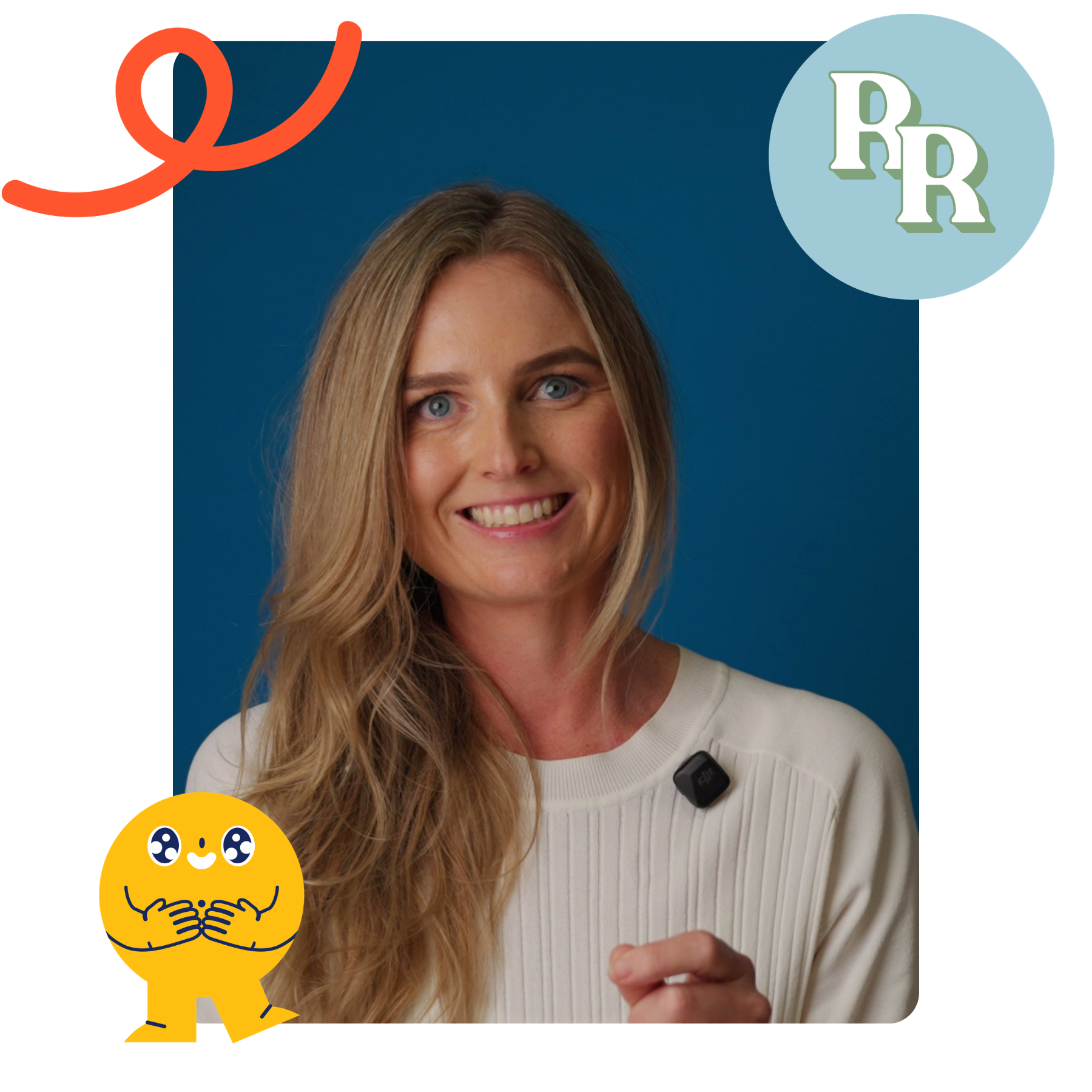
I'm a Paediatric Occupational Therapist who has spent my career working within and alongside early childhood education. As the former National Manager of Occupational Therapy for one of Australia's largest early learning providers, I supported practice across approximately 650 services nationally.
Through national professional development, consultation and my independent work, I've supported thousands of educators. I've seen how deeply they care — and I've watched capable, compassionate educators begin to doubt themselves because the strategies they'd been given didn't make sense for the child in front of them.
Regulation Rituals® brings together Paediatric Occupational Therapy, early childhood practice, national leadership, sensory processing, attachment-informed and neurodiversity-affirming approaches, and years of translating complex knowledge for educators.
It hasn't been created to make early childhood feel more clinical — but more connected, thoughtful and human.
The value isn't only in what each educator learns individually. It's in what becomes possible when the people working together each day understand the work together.
Kindy Uplift (QLD) and Preschool Boost (SA) planning both prioritise the capabilities this program builds. We can supply the quote, invoice and program documentation to support your planning — and services remain responsible for confirming their own funding conditions. See the full alignment →
Access for up to 10 named educators from one service. Each receives all eight modules, 12 months of access, participant resources, invitations to the next relevant live cohort, and a certificate on completion.
One named participant, the complete eight-module program, 12 months of access, participant resources and invitations to the next relevant live community of practice.
Approved providers, service groups and organisations seeking access for more than 10 educators can request a tailored licensing proposal — clarifying participant numbers, locations, access and licensing conditions before enrolment.
A formal proposal, quote or invoice can be provided for services seeking approval from an approved provider, leadership team, committee or board.
Join the priority list to receive information about upcoming live cohorts and future enrolment opportunities.
*The Team Licence is purchased as one service licence for $3,497 + GST and includes up to 10 named educators. The $349.70 + GST per-educator figure is the equivalent cost when all 10 included places are allocated; the total licence price remains the same if fewer places are used. Regulation Rituals® is professional education, not Occupational Therapy treatment or an NDIS-funded support.
Develop a shared approach to regulation across the whole team
Move away from deficit-focused or behaviour-only explanations
Support children with varied sensory, developmental and participation needs
Connect regulation with curriculum, intentional teaching and reflective practice
Help educators feel more capable — without expecting them to become therapists
The program takes a universal, inclusive approach. A child doesn't need a diagnosis for educators to benefit.
A compliance-based behaviour-management program
A promise that difficult behaviour will disappear
A scripted response for every child
A checklist to be applied without reflection
A collection of sensory activities without the understanding beneath them
It's practical, but not simplistic. It respects children too much to pretend one strategy works for everyone — and educators too much to reduce their work to another laminated card.
The learning experience
As a registered health professional with AHPRA, I'm not able to use testimonials or make claims about outcomes — so I won't. What I can share is some of the things educators have let me know about accessing the content and communicating with one another as a team. In their words:
“The course increased our confidence in discussing the concepts as a team.”
“We came away with a clearer shared language.”
“The content helped us reflect more deeply on our everyday practice.”
Feedback relates to the professional learning experience — communication, clarity of the modules and usefulness of the resources — not to clinical or child outcomes.
No. It contains eight modules, but it isn't an eight- or ten-week course. Participants receive 12 months of access and move through the learning at a pace that's manageable for them and their service.
Two circles run every week during school terms, at different times, so there is usually one that fits around shifts. They are live sessions with Sally where educators bring what is actually happening in their rooms, and we work through how the ideas land in a real service. Every educator on your licence can attend. Coming along is never required to complete a module, so missing one does not mean falling behind, and many services send one or two people each week who bring it back to the team.
It sits inside the Regulation Rituals® app, alongside your modules. It is not a social media group, and it is not public. Every educator on your licence has their own access. Educators use it to bring the moments they are still thinking about, to hear how other services have approached something similar, and to ask questions directly.
Yes. You can register throughout the year. Community access begins as soon as your team is enrolled, and you will be invited to the next learning circles running that term.
It's an educator professional development and capacity-building program created and delivered by an Occupational Therapist. It provides general professional education and is not an individual OT assessment, diagnosis or treatment service, and doesn't provide child-specific clinical recommendations.
No particular behavioural, developmental or clinical outcome is guaranteed. Regulation Rituals® strengthens educator understanding and supports more thoughtful, inclusive practice. Children's behaviour and development are influenced by many interacting personal, relational, environmental and systemic factors.
Up to 10 named educators from one enrolled service. It's purchased as one service licence for $3,497 + GST; the per-educator figure is the equivalent when all 10 places are allocated. Services or providers needing more than 10 places can request a tailored proposal.
Services may use their professional reflections, team discussions and implementation planning within broader quality-improvement processes. Participation doesn't guarantee a particular assessment or rating outcome; each service remains responsible for how its practice aligns with the National Quality Standard.
Yes. Participants who complete the eight modules receive a certificate documenting their participation. Registered professionals remain responsible for determining how the learning relates to their individual CPD requirements.
They need a way to make sense of what they're already seeing. Give your team a shared, evidence-informed approach to regulation — and one clear place to begin.
Regulation Rituals® is an educator professional development and capacity-building program. It provides general professional education and reflective learning and does not constitute individual Occupational Therapy assessment, diagnosis, treatment or clinical advice. It does not guarantee particular behavioural, developmental, regulatory, educational, workforce, assessment-and-rating or service-level outcomes.
Experiences and outcomes vary according to participants, children, service context, implementation and other factors beyond the program. References to research describe the bodies of knowledge informing the learning and should not be interpreted as proof of a particular result. Live sessions provide general professional education and implementation support, not child-specific assessment or clinical recommendations. Where individual clinical advice is required, families and services should seek appropriately qualified support through a separate referral, consent process and service agreement.
Your Early Education OT provides professional learning, consultation and capacity-building support. Website content and programs are educational in nature and do not replace individual occupational therapy assessment, diagnosis or treatment.
© 2026 Your Early Education OT. All rights reserved. Regulation Rituals® is a registered trademark.

Get started today before this once in a lifetime opportunity expires.