What rest actually looks like for a four year old in a ten hour day
Sep 17, 2026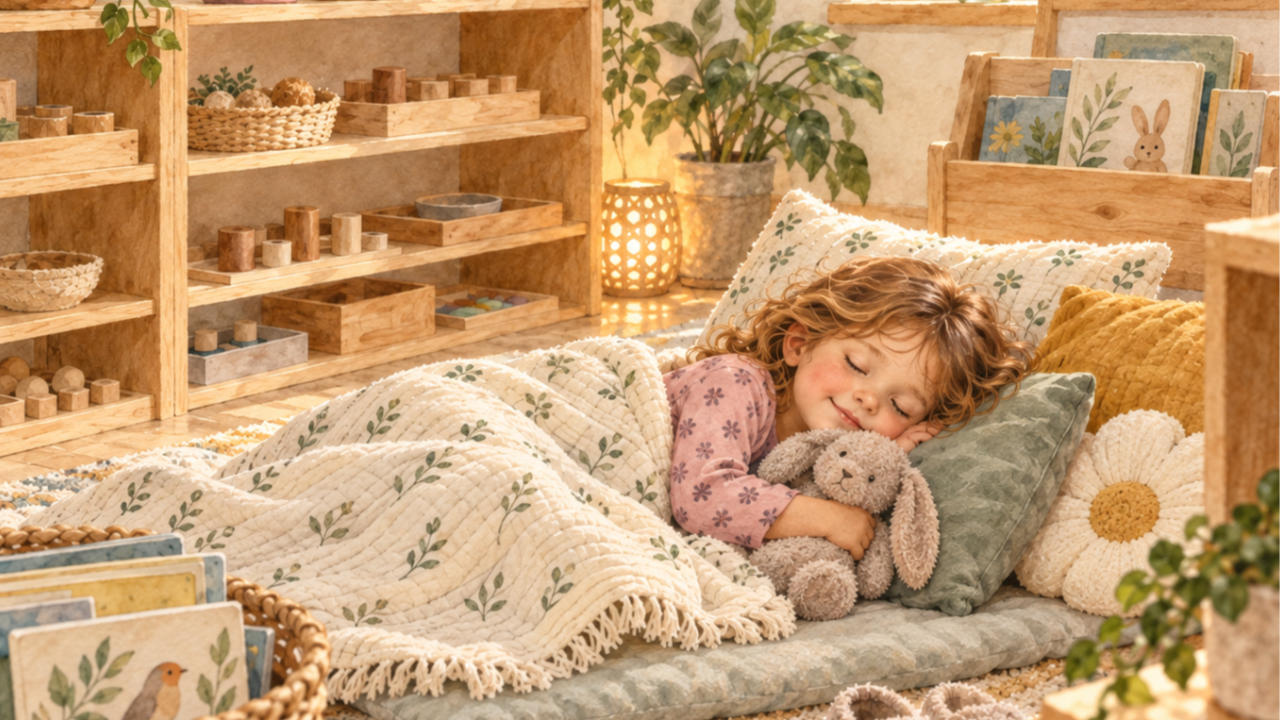
It is just after one o'clock. The mattresses are down, the blinds are drawn, the music is on. Six children are asleep. Fourteen are not. One is lying very still with her eyes open, watching the ceiling fan. Another has rolled off his mattress twice and been walked back twice. You are patting a back with one hand and mouthing something to your colleague across the room, and there are forty minutes of this left.
If you have ever stood in that room and thought there has to be a better way to do this, you are not imagining it. The Australian research agrees with you, and so does the National Quality Framework. I want to walk you through what they actually say, because it changes what a quiet corner is for.
Sleep is one kind of rest. Rest is much bigger than that.
We have become quite good at talking about children's sleep. We are getting better at talking about children's physical activity. The interesting gap sits in between the two, and it is rarely discussed at all.
Across a long day in a group room, what opportunities does a child actually have to reduce demand? Not because they are melting down. Not because they have done something wrong. Not because an educator has sent them somewhere to calm down. Not even necessarily because they are sleepy. Simply because human beings move between periods of engagement and periods of recovery, and a four year old is a human being having a fairly demanding day.
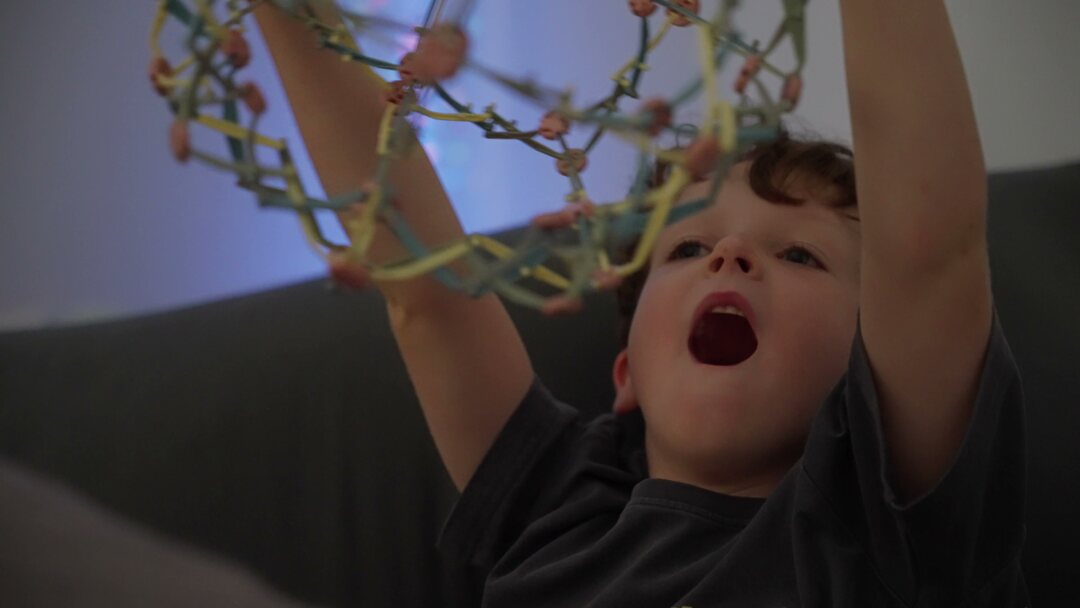
Once you separate rest from sleep, the picture opens up. For one child, rest is sleep. For another it is lying down with a book. For another it is sitting on their own and drawing, or listening to a story beside a familiar adult, or doing something quiet and repetitive with blocks that nobody interrupts. For another it is stepping into a visually simpler, quieter space and doing very little for ten minutes before rejoining the room. All of that is rest. Only one version of it involves a mattress.
What a day in a group room actually asks of a child
The Australian Government's 24-Hour Movement Guidelines are worth reading with this in mind, because they treat the day as one integrated whole rather than a set of separate boxes. For children aged three to five, the guidance is at least three hours of physical activity spread across the day, including at least one hour of energetic play, along with ten to thirteen hours of good quality sleep, with the acknowledgement that some children will still need naps. There is also a line that gets very little attention in early learning: children should not be restrained or kept inactive for more than an hour at a time.
Read together, that is not a picture of active, active, active, everybody lies down for an hour, active again. It is a picture of a day with genuine variation in it. Variation in intensity, in movement, in noise, in social demand, in how much thinking is required, and in how much opportunity there is to recover.
And the recovery part matters, because being in a group environment asks a great deal of a developing nervous system. Across a day a child is continuously navigating social interaction, noise, shared resources, transitions, communication, waiting, group expectations, negotiating play, holding back an impulse, separation and reunion, and adapting to what other people need. Some studies have found that cortisol tends to rise across the childcare day for some preschool aged children, where at home it generally declines, although there is real variation between children, settings and relationships. I would not take that to mean group care is harmful, because that is not what it shows. I would take it to mean the day is genuinely demanding, and that access to periods of lower demand makes developmental sense.
What the Australian research found about mandatory nap times
This is where the work of Sally Staton, Karen Thorpe and colleagues at QUT and the University of Queensland becomes very difficult to look away from.
In an observational study published in Behavioral Sleep Medicine in 2017, the team watched what actually happened in 113 preschool rooms, involving 2,114 children. They found that 83.5 per cent of those rooms ran a mandatory nap time, meaning a period where children were required to lie on their beds with no alternative activity permitted. The length ranged from fifteen minutes to a little over two hours. Across all those rooms, 31 per cent of children napped. And only 14.2 per cent of settings offered an alternative activity across the nap period.
Sit with those numbers for a moment. In most rooms, most children were lying awake, with nothing else available to them, for a substantial part of the afternoon.
The same group found in 2015, published in the Journal of Developmental and Behavioral Pediatrics, that children who experienced more than sixty minutes of mandatory nap time had less night time sleep than children who experienced sixty minutes or less, and that the difference was still present twelve months later once those children had started school. Napping in care was the pathway that explained the link. This was observational research, so it is an association rather than proof of cause, but it is a consistent one. Their systematic review in Archives of Disease in Childhood, also in 2015, looked across twenty six studies and found the most consistent finding was that beyond the age of two, napping was associated with later sleep onset and shorter or poorer quality night sleep. The evidence on behaviour, cognition and health was much less certain, which they say plainly.
And then there is the study I find most useful of all. In Scientific Reports in 2018, the team tested the assumption underneath the whole practice, which is that a mandated nap time is restful. They measured salivary cortisol across the day. Mandated nap times did not reduce children's cortisol. The authors concluded that nap time appeared to be neither stressful nor restful, and noted that children who could not sleep under mandated conditions showed no significant decline in cortisol between the end of nap time and bedtime.
I want to be careful about what this does and does not say, because it is easy to overreach here. It is not evidence that children do not need rest. It is not evidence that sleep does not matter, and it is certainly not an argument against a child who needs a nap having one. What it is, quite precisely, is evidence that requiring a child to lie still is not the same thing as giving that child rest.
The National Quality Framework is already asking for this
Here is the part that surprises most services. None of this is a fringe position. It is close to what the framework already expects.
Element 2.1.1 asks that each child's wellbeing and comfort is provided for, including appropriate opportunities to meet each child's need for sleep, rest and relaxation. The assessment guidance underneath it is where it gets specific. Assessors may observe children who do not require, or choose not to, sleep or rest being given choice and opportunities to engage in quiet play experiences. They may observe educators providing a range of active and restful experiences throughout the program and supporting children's preferences for participation. And they may observe comfortable spaces being made available for children away from the main activity area to rest and engage in relaxation.
That last line is worth reading twice. A comfortable space, away from the main activity area, for a child to rest and engage in relaxation. That is a retreat space, described in the assessment guidance, in almost exactly those words.
The framework also says that children have a right to both passive and active leisure, that passive leisure is how a child might re-energise or reset, and that leisure is intrinsically valuable and does not have to be productive. ACECQA's own guidance on children's right to sleep and rest, published in March 2026, connects this to Element 5.1.2 and to Article 31 of the United Nations Convention on the Rights of the Child, and encourages services to provide quiet spaces for both sleep and passive leisure, to run flexible routines so children can follow their individual needs, and to support a child's request to rest when they identify it.
One more thing sits underneath Element 2.1.1 that I think deserves attention, and that is Section 166, the offence of using inappropriate discipline. It is worth holding alongside everything above, because the moment a quiet space becomes the place children are sent when their behaviour is hard, it has stopped being a rest space and become something else entirely. The nervous system knows the difference even when the furniture does not change.
So what is a retreat space, and how do you use it?
A retreat space is not where we send dysregulated children. It is one way we intentionally design an early learning environment so that children have access to rest, reduced demand and quieter participation right across their day, rather than in a single block at one o'clock.
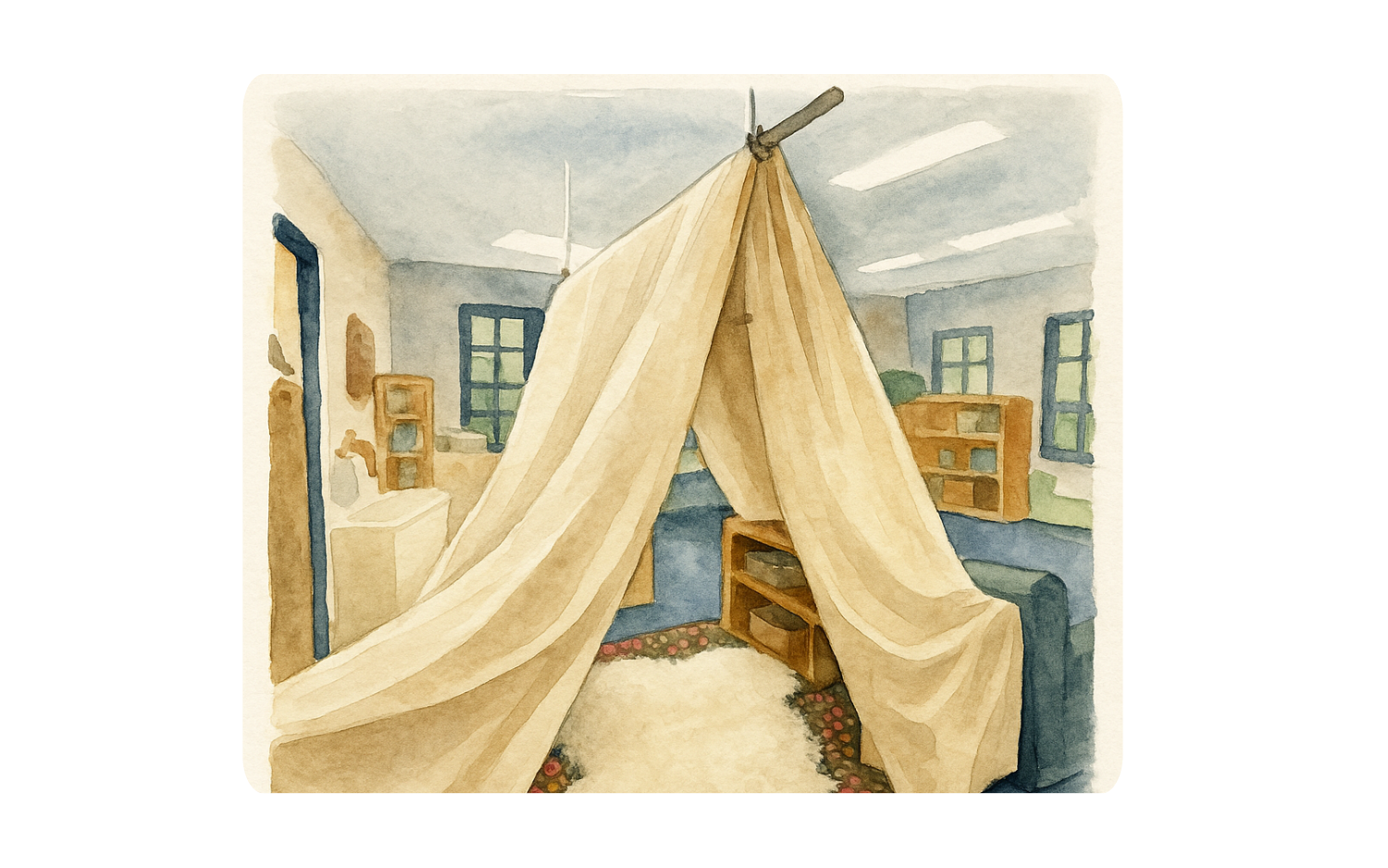
Underneath a space that works, there are five design principles doing the quiet labour: emotional safety, predictability, sensory comfort, accessibility and independence. Emotional safety means a child is never made conspicuous by going there. Predictability means the space looks and works the same way on Tuesday as it did on Monday. Sensory comfort means somebody has thought about the light, the sound, the texture and what is visible from inside it. Accessibility means a child can get there without asking permission. Independence means they can use it, and leave it, without an adult managing the whole transaction.
Location does more work than furnishings. A retreat space needs to be visible to educators but not exposed to the room, which is a harder balance than it sounds and is the decision most services get wrong first. Tucked behind a shelf in the loudest corner of the room will not work no matter what you put in it.
Then there is the language, which is where most of the difference actually lives. There is an enormous gap between "you need to go to the calm corner" and "the quiet space is there if you want it". The first is a direction, and a child will read it as a consequence. The second is an invitation, and a child will read it as a choice. Same corner, same cushions, completely different message to the nervous system. Reading those phrases aloud at a team meeting is genuinely how new language becomes natural language, because nobody changes how they speak under pressure by reading it silently once.
And it should be available all day. That is the shift this research points to most directly. If the only time a child can reduce demand is the forty minutes after lunch, a great many children will never get what they need, and the ones who cannot sleep will spend that time doing something that is neither restful nor useful.
Three things you could change this week
The first is to walk your space standing up. Go and stand in the corner at child height, during a busy part of the morning rather than after hours, and ask whether it passes those five principles. Standing in the room at ten in the morning and sitting at the desk at five in the afternoon produce genuinely different answers, and only one of them is useful.
The second is to listen to your own language for one day. Not to change it yet, just to hear it. Count how many times the quiet space is offered and how many times it is directed. Most educators are surprised, and nobody needs to feel bad about it, because this is a habit rather than a value.
The third is to take something out before you add anything in. Subtraction is almost always the fastest improvement available to a service, and it is the only one that costs nothing. The most common thing working against a retreat space is not an absence, it is a well intentioned addition that somebody bought in good faith.
It is one o'clock again tomorrow. The mattresses will come down, and six children will sleep, and fourteen will not. The question I would leave you with is not whether your rest time is working, because you already know the answer to that. It is a quieter one. Across the whole of a nine or ten hour day, when does a child in your room get to stop working so hard? If the honest answer is only when they are asleep, or only when something has gone wrong, that is worth a conversation with your team.
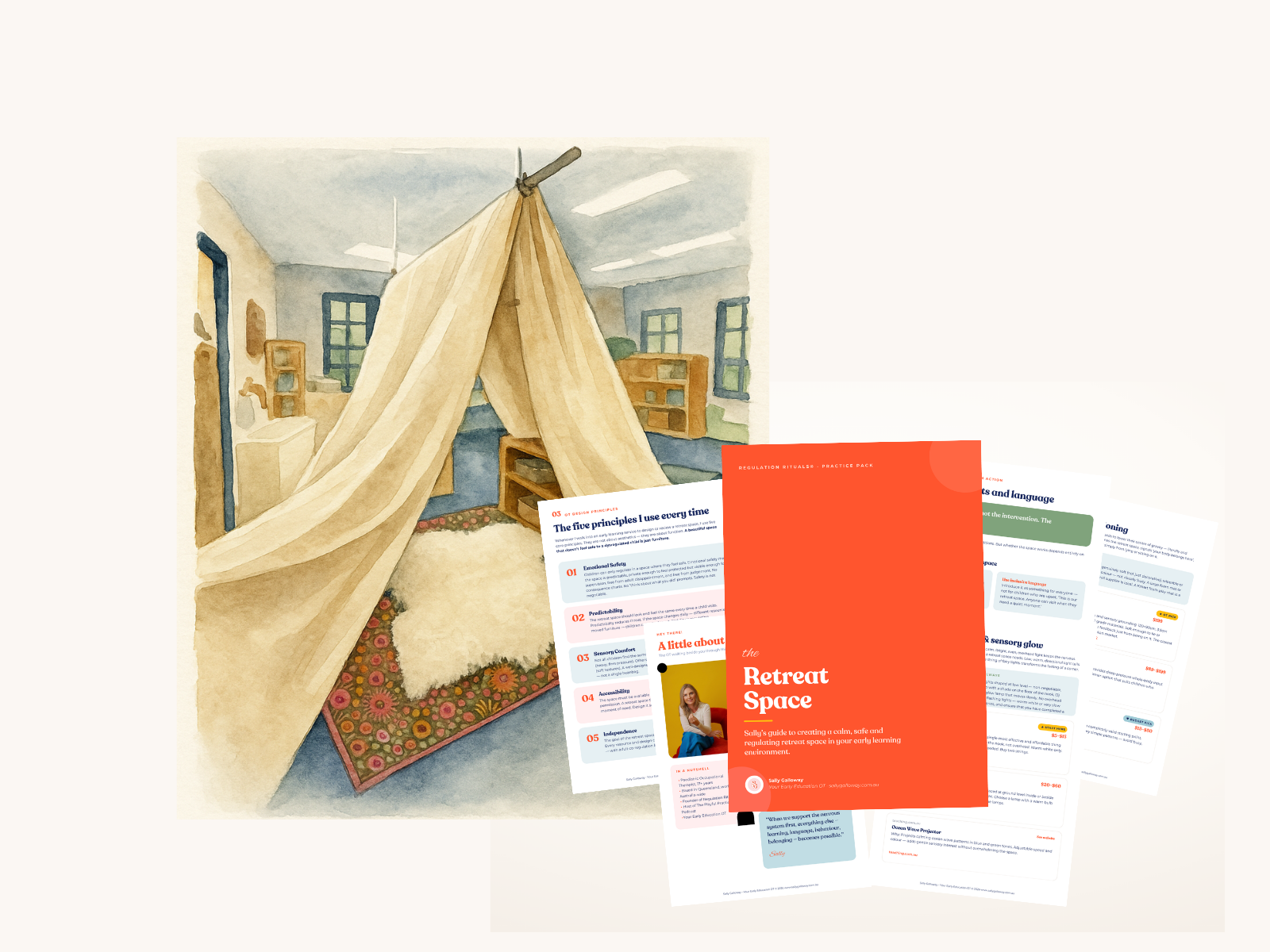
If you would like the reasoning written down, including the five design principles, where the space belongs in the room, the seven things I would leave out, the educator scripts, six child profiles and an audit tool you can take into the space, it is all in The Retreat Space Practice Pack. It is nine pages, it costs seventeen dollars, and it includes a researched Australian buying guide so you are not standing in front of a catalogue at nine at night trying to work out which option is worth the money.
Get The Retreat Space Practice Pack for $17 →
Instant digital download, print-ready, yours to keep and print for your whole service.
Get the Insider
Free, practical writing for early childhood educators. Straight to your inbox.
No spam, ever. Unsubscribe in one click, any time.